
Each voice unit (SST) consists of a microphone (MK) and a speaker module (SM) with an integrated loudspeaker.
The car speaker module is connected via socket SST1, mounted behind an existing speaker grille, and connected to the alarm device using a system cable with RJ45 connectors on both ends.
The car microphone can be connected either to the speaker module or directly to the NRT via socket MIC1.
A maximum of two external speaker modules can be connected to the NRT (SST1 and SST2).
Connection of speaker module and microphone
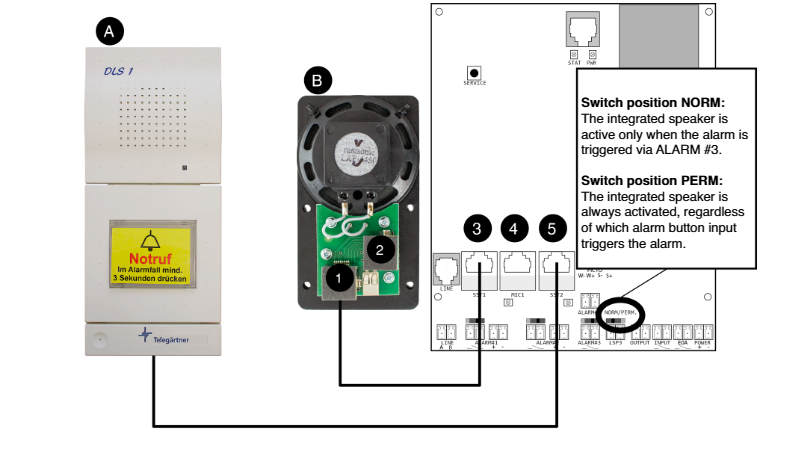
A. Intercom station DLS 1 for installation beneath the car.
B. Speaker module SM 1 used as loudspeaker for the car.
-
Socket “X1” of the speaker module: The car microphone or a system cable for connecting the speaker module to the NRT can be connected here.
-
Socket “X2” of the speaker module: The car microphone or a system cable for connecting the speaker module to the NRT can be connected here.
-
Socket “SST1” / “MIC1” on the NRT: The car microphone or a system cable for connecting the NRT to the car speaker module can be connected here.
-
Socket “MIC1” on the NRT: The car microphone or a system cable for connecting the NRT to the car speaker module can be connected here.
-
Socket “SST2” on the NRT: An additional voice unit (DLS 1, SM 1, SM 2) for use beneath the car can be connected here.
Simultaneous connection of a microphone to both the voice unit and NRT is not permitted and will cause malfunction.
By changing the configuration, the internal loudspeaker can also serve as a central loudspeaker. In this case, no separate speaker modules are required. Set the slide switch above the internal loudspeaker connection to the “PERM.” (Permanent) position. The internal loudspeaker will remain permanently active, and only additional microphones are required. However, this configuration is recommended only for acoustically open cars.